

Đề thi thử THPT quốc gia năm 2018 môn Tiếng Anh - Nguyễn Thị Thu Thủy (Có đáp án)
 5 trang
04/12/2025
620
5 trang
04/12/2025
620
Bạn đang xem tài liệu "Đề thi thử THPT quốc gia năm 2018 môn Tiếng Anh - Nguyễn Thị Thu Thủy (Có đáp án)", để tải tài liệu gốc về máy hãy click vào nút Download ở trên.
Tóm tắt nội dung tài liệu: Đề thi thử THPT quốc gia năm 2018 môn Tiếng Anh - Nguyễn Thị Thu Thủy (Có đáp án)
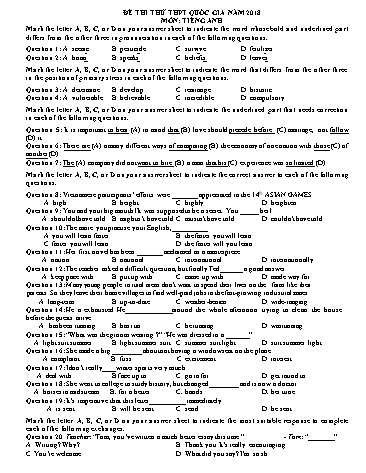
 ĐỀ THI THỬ THPT QUỐC GIA NĂM 2018
 MÔN: TIẾNG ANH
Mark the letter A, B, C, or D on your answer sheet to indicate the word whose bold and underlined part
differs from the other three in pronunciation in each of the following questions.
Question 1: A. scenic B. pesticide C. survive D. fertilizer
Question 2: A. boats B. speaks C. beliefts D. leaves
Mark the letter A, B, C, or D on your answer sheet to indicate the word that differs from the other three
in the position of primary stress in each of the following questions.
Question 3: A. determine B. develop C. rearrange D. historic
Question 4: A. vulnerable B. believable C. incredible D. compulsory
Mark the letter A, B, C, or D on your answer sheet to indicate the underlined part that needs correction
in each of the following questions.
Question 5: It is important to bear (A) in mind that (B) love should precede before (C) marriage, not follow
(D) it.
Question 6: There are (A) nmany different ways of comparing (B) the economy of one nation with those (C) of
another (D).
Question 7: The (A) company did not want to hire (B) a man that his (C) experience was so limited (D).
Mark the letter A, B, C, or D on your answer sheet to indicate the correct answer to each of the following
questions.
Question 8: Vietnamese participants’ efforts were _______ appreciated in the 14th ASIAN GAMES.
 A. high B. height C. highly D. heighten
Question 9: You and your big mouth! It was supposed to be a secret. You _____ her!
 A. shouldn't have told B. mightn’t have told C. mustn't have told D. couldn't have told
Question 10: The more you practise your English,__________.
 A. you will learn faster B. the faster you will learn
 C. faster you will learn D. the faster will you learn
Question 11: Her first novel has been _______ acclaimed as a masterpiece.
 A. nation B. national C. international D. internationally
Question 12: The teacher asked a difficult question, but finally Ted______ a good answer.
 A. keep pace with B. put up with C. came up with D. made way for
Question 13: Many young people in rural areas don’t want to spend their lives on the farm like their........
 parents. So they leave their home villages to find well-paid jobs in the fast-growing industrial zones.
 A. long-term B. up-to-date C. weather-beaten D. wide-ranging
Question 14: He is exhausted. He around the whole afternoon trying to clean the house
before the guests arrive.
 A. has been running B. has run C. be running D. was running
Question 15: “What was the groom wearing ?” “He was dressed in a ______”
 A. light suit summer B. light summer suit C. summer suit light D. suit summer light
Question 16: She made a big ________ about not having a window seat on the plane.
 A. complaint B. fuss C. excitement D. interest
Question 17: Idon’t really__ _winter sports very much.
 A. deal with B.face up to C. go in for D. get round to
Question 18: She went to college to study history, but changed ________ and is now a doctor.
 A. horses in midstream B. for a better C. hands D. her tune
Question 19: It’s imperative that this letter__________ immediately.
 A. is sent B. will be sent C. send D. be sent
Mark the letter A, B, C, or D on your answer sheet to indicate the most suitable response to complete
each of the following exchanges.
Question 20. Teacher: “Tom, you’ve written a much better essay this time.” - Tom: “_______”
A. Writing? Why? B. Thank you. It’s really encouraging.
C. You’re welcome. D. What did you say? I’m so sh Although he has received a few minor changes throughout his lifetime, most notably the addition of
white gloves and the rounder forms of a more childish body, he has remained true to his nature since those first
cartoons. Mickey is appealing because he is nice. He may get into trouble, but he takes it on the chin with a
grin. He is both good-natured and resourceful. Perhaps that was Disney's own image of himself. Why else
would he have insisted on doing Mickey's voice in all the cartoons for twenty years? When interviewed, he
would say, "There is a lot of the mouse in me." And that mouse has remained one of the most pervasive images
in American popular culture.
Question 31: Which of the following is the main topic of the passage ?
 A. The image of Mickey Mouse B. The life of Walt Disney
 C. The history of cartoons D. The definition of American culture
Question 32: The word “pervasive” could best be replaced by.................
 A. wel loved B. widespread C. often copied D. expensive to buy
Question 33: The word “appealing” is closet in meaning to........
 A. attractive B. famous C. exceptional D. distinguishable
Question 34: The word “those” refers to..................
 A. cartoons B. forms C. gloves D. changes
Question 35: What did Disney mean when he said, “There is a lot of the mouse in me” ?
 A. He was proud of the mouse that he created
 B. He knew that the mouse would be a famous creation
 C. He created the mouse with many of his qualities.
 D. He had worked very hard to create the mouse.
Question 36: The first image if Mickey Mouse is descirbed as all of the following EXCEPT.........
 A. He was dressed in shorts with two buttons. B. He had big ears.
 C. He wore yellow shoes D. He was wearing white gloves.
Question 37: The paragraph following the passage most probably discusses..........
 A. the history of cartoons B. other images in popular culture
 C. Walt Disney’s childhood D. the voices of cartoon characters
Read the following passage and mark the letter A, B, C, or D on your answer sheet to indicate the correct
answer to each of the questions.
 Prehistoric horses were far removed from the horses that Christopher Columbus brought on his ships during
his second voyage to the New World. Although fossil remains of “dawn horses” have been excavated in several
sites in Wyoming and New Mexico, these animal, which were biologically different from contemporary horses,
had been extinct several millennia before onset of the Indian era. Although moviegoers visualize an Indian as a
horse rider, Indians were not familiar with horses until the Spanish brought them to Mexico, New Mexico,
Florida, and the West Indies in 1519. Those that escaped from the conquerors or were left behind became the
ancestors of the wild horses that still roam the southwestern regions of the country. The Indian tribe scattered in
the western plains began to breed horse about 1600.
 The arrival of the horse produced a ripple effect throughout the Great Plains as the Indians living there were
not nomadic and engaged in rudimentary farming and grazing land hunting. Tracking stampeding herds of
buffalo and elk on foot was not the best way to stock quantities of meat to adequately feed the entire tribe
during the winter. However, mounted on horses, the hunting team could cover ground within a substantial
distance from their camps and transport their game back to be roasted, dried into jerky, or smoke for
preservation. The hunters responsible for tribe provisions stayed on the move almost continuously, replacing
their earth-and-sod lodges with tepees. Horses carried not only their riders but also their possessions and booty.
The Blackfoot Indians of the Canadian plains turned almost exclusive hunters, and the Crow split off from the
mainstream Indian farming in favor of hunting. In fact, some of the Apache splinter groups abandoned
agricultural cultivation altogether.
 The horse also drastically altered Indian warfare by allowing rapid maneuvering before, during, and after
skirmishes. With the advent of the horse, the Apache, Arapahoe, and Cheyenne established themselves as
territorial monopoly in the Plains. Because Indians did not have the wheel and had dragged their belongings
from one settlement to another, horse also enabled them to become more mobile and expedient during tribal
migration. In fact, the Cheyenne abolished the custom of discarding belongings and tepee skins simply because
there were no means to transport them KEYS
1. A 2.D 3.C 4.A 5.C 6.C 7.C 8.C 9.A 10.B
11.D 12.C 13.C 14.A 15.B 16.B 17.C 18.A 19.D 20.B
21.C 22.B 23.D 24.B 25.D 26.C 27.C 28.D 29.B 30.C
31.A 32.B 33.A 34.A 35.C 36.D 37.B 38.C 39.B 40.B
41.A 42.D 43.B 44D 45A 46.A 47.D 48.B 49.B 50.A
 Giáo viên: Nguyễn Thị Thu Thủy
 Tổ: Ngoại ngữ
File đính kèm:
- de_thi_thu_thpt_quoc_gia_nam_2018_mon_tieng_anh_nguyen_thi_t.doc

